
Two Ways to Sell an Estate's Contents
When an estate has items worth selling, executors in Toronto usually choose between an online auction, most often through MaxSold, and a traditional on-site estate sale. Both can work. They differ in timeline, security, pricing and how much the family has to be involved.
This comparison draws on our estate auction coordination and sale preparation work across the GTA.
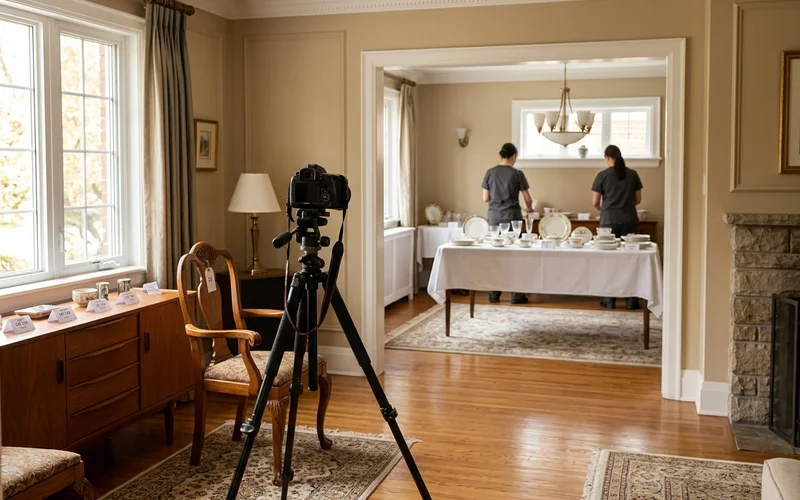
Side-by-Side Comparison
| Factor | MaxSold online auction | On-site estate sale |
|---|---|---|
| Timeline | Cataloguing, a bidding window of several days, then pickup | Preparation, then one or more sale days |
| Foot traffic | Winning buyers only, on a booked pickup day | Many buyers browsing the home |
| Security | Easier to control | Needs door staff, closed rooms, secured valuables |
| Pricing | Market sets the price through bidding | Fixed prices, discounted as the sale goes on |
| Buyer reach | Wide online audience | Local buyers who visit |
| Best for | Antiques, art, silver, collections, mid-century | High volume of mid-value items |
| Neighbors and parking | Minimal impact | Noticeable traffic and parking |
| Fees | 15% of hammer price, no upfront cost | Varies with preparation and staffing |
| Records | Settlement statement per lot | Sale records |
Timeline
An online auction runs on a set rhythm: a few days of cataloguing and photography, a bidding window of several days, then a pickup day. A sale needs similar preparation time, but the selling happens over a weekend. If you have a hard deadline, both can work. Large estates often run auction waves while the rest of the home is sorted.
Security and Foot Traffic
This is the biggest difference. At an on-site sale, dozens of strangers walk through the home. That needs careful planning: door control, closed private rooms, jewelry secured or removed, and staff in every area. An online auction limits visitors to a scheduled pickup, where buyers collect only their lots.

Pricing Control
At a sale, you approve fixed prices, which gives control but risks under-pricing valuable items or over-pricing ordinary ones. At auction, bidders set the price. For unusual or collectible items, competitive bidding often surprises families on the upside.
Net Returns
Returns depend entirely on what is being sold. For reference, the Thompson family's 5-bedroom Lawrence Park estate, with 40 years of art and antiques, returned $38,000 across 3 MaxSold auction waves. Our coordination fee is 15% of hammer price with no upfront cost, and every lot is recorded in the documentation package.
When each fits
Choose online auction when contents are valuable, varied or collectible, or when security and neighbors are a concern. Choose an on-site sale when there is a large volume of mid-value items and the family is comfortable opening the home. Combine both when the home has some of each.
Combining Routes
Many estates do both. The most valuable items go online, an estate sale preparation plan handles the everyday contents, and anything unsold after the sale goes to auction, donation or recorded disposal. Keepsakes are always removed first.
What Each Option Asks of the Family
Families often choose between auction and sale based on how much involvement they want. An online auction asks very little of the family once keepsakes have been removed: approve the list of lots, then wait for results. The house remains closed except on pickup day. An on-site sale asks more. Family members often want to be nearby on sale days, the home is open to visitors, and decisions about discounts and unsold items have to be made quickly.
For executors who live out of town, online auction is usually the simpler choice. For families who live nearby and like the idea of neighbors and collectors giving items a new home in person, a sale can feel more personal.
Common Mistakes to Avoid
- Holding a sale before keepsakes are removed. Once a stranger has bought an item, it is gone for good.
- Pricing valuables at sale prices. Silver, art and collectibles often fetch more through competitive online bidding.
- Forgetting the day after. Both routes leave unsold items. Decide in advance where they go.
- Ignoring the neighbors. Sale traffic and parking can strain relationships on a quiet street.
- Not keeping records. Beneficiaries may want to know what sold and for how much. Settlement statements and sale records answer that.
| Situation | Better fit |
|---|---|
| Executor lives far away | Online auction |
| Large volume of mid-value contents | On-site sale |
| Small number of valuable pieces | Online auction |
| Family wants minimal foot traffic | Online auction |
| Neighborhood with collectors and walk-in buyers | On-site sale, with auction for valuables |
Making the Decision
Walk the home with someone who has run both. At a free consultation we look at what is in the house, talk about your timeline and comfort with visitors, and recommend a mix that suits your estate.