
Why Receipts Matter to Executors
When an estate donates furniture and household goods, the charity may issue a receipt. For the executor, those receipts are two things at once: a record of where estate property went, and a document your accountant may use when preparing the estate's tax return. Collecting them properly is part of good donation coordination.
This guide explains how receipts are collected and filed. It is not tax advice. Your accountant decides how receipts are used.

How Receipt Collection Works
1. Donate in the estate's name
When we deliver donations, we ask the charity to issue receipts in the estate's name, using the details the executor provides. Where a charity does not issue receipts for certain items, we record the donation anyway.
2. Record what was given
For every delivery, we note the date, the charity, the location and a general description of what was donated, such as "dining set, six chairs, 12 boxes of housewares".
3. File the receipts
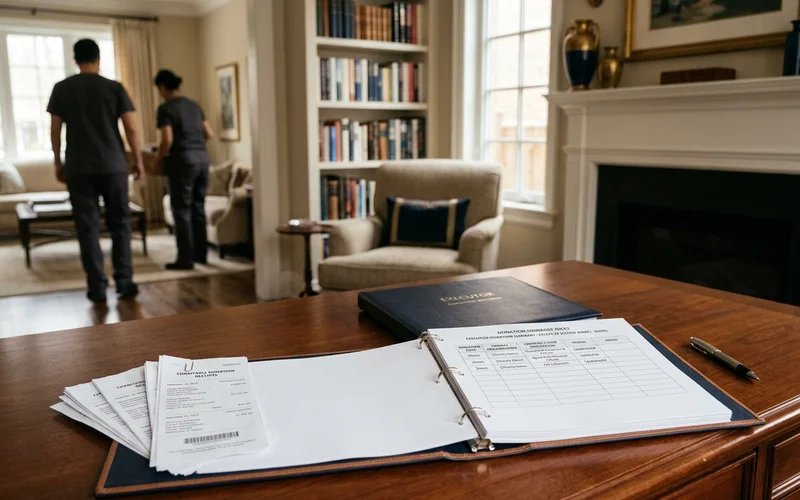
Receipts and the donation summary are filed together in the executor's documentation package, so nothing is scattered across family members' kitchen drawers.
4. Hand to your accountant
You, or we with your authorization, pass the receipts to the estate's accountant, who decides how they apply.
What Details Usually Appear on a Receipt
| Detail | Why it matters |
|---|---|
| Charity name and registration number | Identifies the registered charity |
| Donor name | Ideally the estate |
| Date of donation | Links the receipt to the clearing schedule |
| Description of items | Shows what was given |
| Value, where the charity assigns one | Determined by the charity's own policy |
Things to Know
- Policies vary. Not every charity issues receipts for in-kind household donations, and those that do have their own rules on valuation.
- Receipts are records first. Even without tax value, they show beneficiaries that items were donated, not lost.
- Keep everything together. Our documentation package files receipts alongside the inventory, auction statements and disposal manifests.
No tax advice, by design
We collect receipts and record donations accurately. We do not advise on whether or how they affect the estate's taxes. That is your accountant's role.
A Sample Donation Summary
Alongside the receipts themselves, the documentation package includes a donation summary so the executor and accountant can see everything on one page.
| Date | Charity | Location | Contents | Receipt |
|---|---|---|---|---|
| Day 3 | Habitat for Humanity ReStore | Nearest store | Dining set, kitchen cabinets, light fixtures | On file |
| Day 4 | Salvation Army | Donor centre | 14 boxes of housewares, linens, books | On file |
| Day 5 | Community furniture bank | Warehouse | 2 beds, 2 dressers, sofa | On file |
| Day 6 | Toronto Goodwill | Donation centre | Clothing, small appliances | As issued |
The summary also notes any donation where a receipt was not issued, so there are no gaps between what left the home and what is recorded.
Common Questions From Accountants
Accountants preparing an estate's final returns often ask the same things. Who donated the items? Our records show they were donated on behalf of the estate. When were they donated? Each delivery is dated. What was donated? The summary describes the contents. Did the charity assign a value? The receipt shows whatever the charity's own policy provides. Our role ends at collecting and organizing these records; how they are used is a professional judgment for your accountant.
Why Keeping Receipts Together Matters
When families clear a home themselves, donation receipts often end up scattered: one in a car, one in a sibling's email, one never requested at all. By the time the accountant asks, some are lost. Having every receipt in one folder, with a summary, saves time and avoids awkward questions from beneficiaries about where things went.
When Charities Do Not Issue Receipts
Some charities do not issue receipts for certain household donations, such as clothing or small housewares, and some only issue receipts above a minimum value. When that happens, we still record the donation in the summary: date, charity, location and contents. The record shows where the items went even without a receipt, which is what beneficiaries most often want to know.
Included on Every Job
Donation documentation and tax receipt filing are included in every estate clearing scope, from partial clears at $2,500 to $4,500 to premium estates at $12,000 to $25,000. You will not see a separate line item for it.
For executors, the value is simple: one folder, every receipt, a clear summary, and no chasing charities months later.